Thermal management in Servo Drives
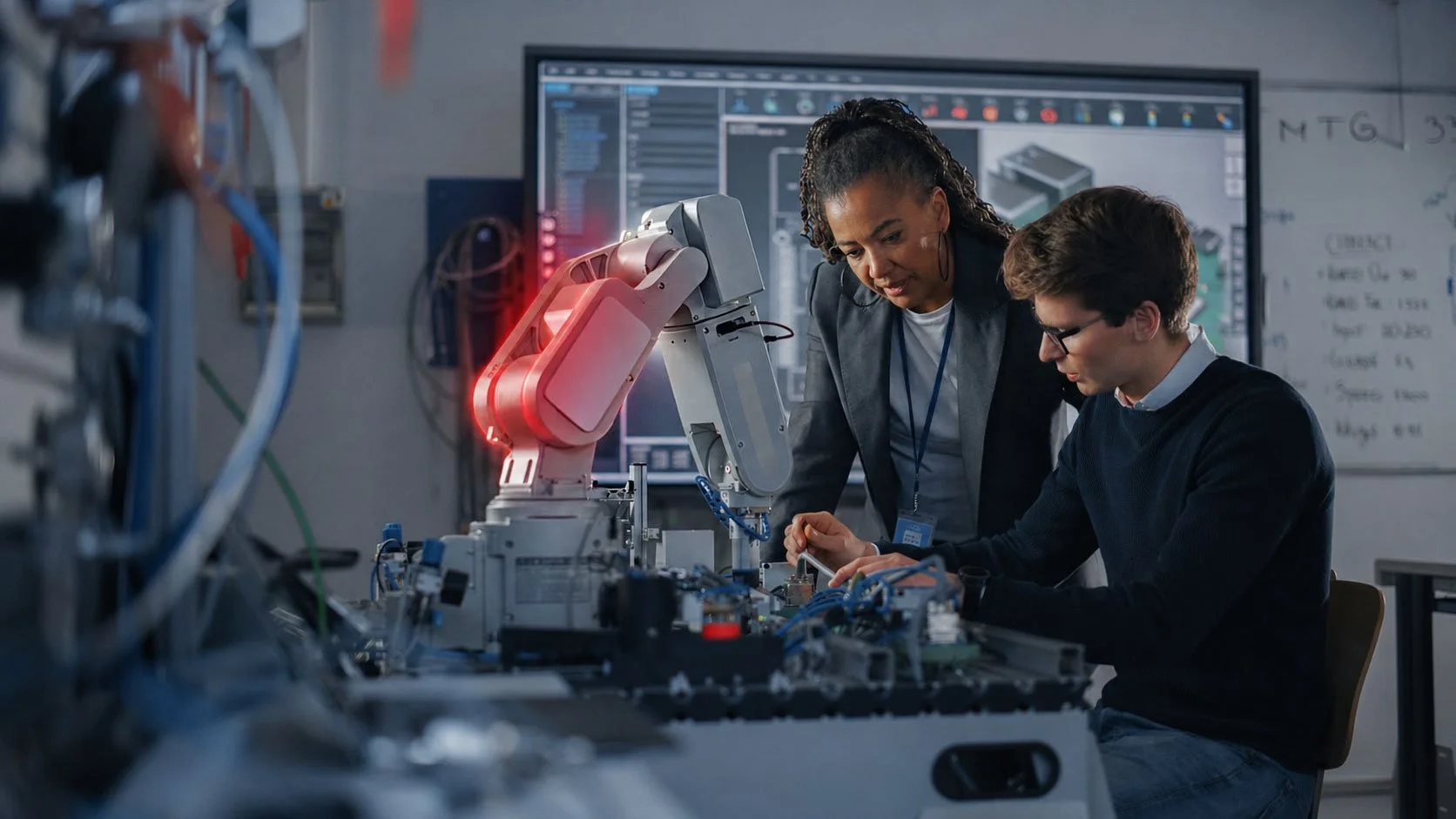
Thermal behavior is often what defines the real limits of a servo system. Not because the electrical design is insufficient, but because heat is difficult to move, difficult to measure correctly, and often ends up in the wrong place.
In practice, thermal constraints influence continuous torque, overload capability, efficiency, sensor accuracy, and lifetime. They also influence how compact a system can be, and how predictable it behaves over time.
This article takes a system-level view of thermal management in servo drives. The focus is on what actually causes problems in real designs, and how those problems can be addressed in a structured way.
Where the heat comes from
Heat in a servo system is distributed across multiple domains, and the relative importance of each source depends strongly on the operating point.
In the motor, copper losses dominate at high torque and low speed. These are straightforward to calculate, but not always straightforward to remove. Iron losses increase with speed and frequency, and can become dominant in high-speed operation. In some designs, magnet losses also become relevant, particularly where harmonics or slotting effects are present.
In the drive electronics, both conduction and switching losses must be considered. Conduction losses scale with current, while switching losses scale with voltage, current, and switching frequency. This creates a trade-off space that is not always obvious early in design.
Passive components are often underestimated. DC-link capacitors, current sensing elements, and gate drivers all contribute heat and have temperature-dependent behavior and lifetime.
At system level, connectors, cables, brakes, bearings, and gear stages introduce additional losses. These are usually smaller, but they influence local temperature and can affect nearby sensitive components.
The important observation is that heat is not generated in one place. It is generated throughout the system, and each location has different conditions for removing it.
Why thermal management becomes difficult in practice
Thermal problems are rarely caused by a single design mistake. They are typically the result of several small limitations interacting.
One of the main drivers is compact integration. Modern servo systems often combine motor, drive, sensors, and mechanics in a confined space. This reduces available cooling surface and increases thermal coupling. Heat generated in one part of the system will influence others, whether intended or not.
Thermal interfaces are a common bottleneck. It is not unusual to see designs where the bulk material has good thermal conductivity, but the actual limitation sits in the interface. Grease thickness, mounting pressure, surface flatness, coatings, and even assembly variation can introduce significant thermal resistance. An anodized aluminum surface, for example, behaves very differently from a machined one when it comes to thermal contact.
Another recurring issue is that the most natural heat path is not always the most useful one. In many servo assemblies, heat tends to flow rearward through the shaft and structure, toward sensors and connectors. This can create temperature rise in encoders or resolvers, leading to reduced accuracy or drift. It can also expose drive electronics to higher ambient temperature than expected.
Directing heat forward into a mechanical structure or gearbox can be beneficial in some cases, but this depends on whether those parts can handle the thermal load. This is a design decision that should be made explicitly, not left as a by-product of geometry.
Duty cycle adds another layer of complexity. Many systems operate far from steady state. Short bursts of high load can generate local heating that is not visible in average power calculations. At the same time, different parts of the system have different thermal time constants. A winding may heat up quickly, while the housing remains relatively cool. This makes it difficult to infer internal temperatures from external measurements.
Ambient conditions are often underestimated. A system that performs well in open air may behave very differently inside a cabinet, near other heat sources, or at elevated ambient temperature.
Hotspots are what usually define the limit
Average temperature is a useful metric, but it is rarely what defines the real limit of a design. Hotspots are.
A hotspot is a localized region with significantly higher temperature than its surroundings. These typically occur where losses are concentrated and thermal resistance is high.
Common examples include:
End-windings in the stator
Semiconductor junctions in the power stage
Rotor magnets
Mechanical interfaces with poor contact
These regions are often small and not directly instrumented. It is not uncommon for a system to appear thermally stable based on case measurements, while an internal hotspot is already approaching a critical limit.
This matters because lifetime is strongly temperature dependent. Insulation systems, capacitors, and semiconductor devices all degrade faster at elevated temperature. A moderate local increase can have a disproportionate effect on lifetime.
Hotspots also influence behavior. A resolver or encoder located near a heat path may experience drift or reduced accuracy. A power stage operating near its junction temperature limit may require derating even if the rest of the system is within acceptable limits.
In practice, this leads to two typical outcomes. Either the system is designed conservatively, with significant derating and unused performance, or it is pushed harder than the actual thermal limits allow.
Low-inductance motors and switching strategy
Small motors, and particularly coreless designs, introduce a less obvious thermal challenge.
These motors often have very low inductance. As a result, current ripple becomes strongly dependent on switching frequency. If the switching frequency is too low, the ripple current increases significantly.
This has a direct consequence. RMS current increases, which increases copper losses, even if the average torque remains the same. In other words, the motor heats up more than necessary.
This is not always immediately visible in system-level discussions, where focus is often on average current or torque. In practice, it means that drive configuration becomes part of the thermal design.
Increasing switching frequency can reduce current ripple and associated losses in the motor. However, this comes at the cost of increased switching losses in the drive electronics. The thermal load is therefore shifted, not removed.
This is a typical example of a cross-domain trade-off:
Lower switching frequency → higher motor losses
Higher switching frequency → higher drive losses
The optimal point depends on the system, including cooling capability on both motor and electronics side.
It is not uncommon to see small motor systems where unnecessary heating is introduced simply because switching strategy was not aligned with motor characteristics.
Heat flow direction is a design parameter
It is useful to ask early in the design: where should the heat go?
Heat will follow available paths. If those paths are not designed intentionally, heat may end up in parts of the system that are sensitive or difficult to cool.
In many servo systems, rearward heat flow leads to elevated temperature in sensor areas and connectors. This can affect both measurement accuracy and component lifetime.
Forward heat flow into a mechanical structure can be beneficial if that structure provides a good thermal sink. Gearboxes and machine interfaces can sometimes absorb and spread heat effectively, but this must be verified. Not all mechanical structures are suitable as thermal sinks.
The key point is that heat flow direction should be part of the system architecture discussion. It should not be left to emerge from geometry alone.
Typical thermal bottlenecks
Across different applications, a number of recurring bottlenecks appear.
Winding temperature is often the primary limit in torque-dense designs. High current density combined with limited heat extraction leads to rapid temperature rise.
Magnet temperature can become the limiting factor in high-speed or poorly cooled rotor designs. NdFeB magnets have temperature-dependent behavior, and irreversible demagnetization becomes a risk if limits are exceeded.
Power electronics may impose limits even when the motor could deliver more. Junction temperature, capacitor lifetime, and driver limits all play a role.
Thermal interfaces are frequently underestimated. A theoretically good heat path may contribute less than expected due to interface resistance.
Sensor areas are sensitive. Even moderate temperature rise can affect accuracy or stability.
These bottlenecks rarely exist in isolation. They interact, and improving one may expose another.
Why system-level simulation is so valuable
Thermal behavior in servo systems is inherently multi-domain.
Electromagnetic behavior defines losses. Losses generate heat. Temperature affects resistance, magnetic properties, and component capability. Mechanical design defines how heat moves. Cooling conditions influence everything.
Understanding this interaction through intuition alone is difficult, especially in compact systems.
System-level simulation provides a way to explore this space before hardware is built. By combining electromagnetic losses, thermal models, and mechanical interfaces, it becomes possible to identify where the real bottlenecks are.
This allows questions such as:
Where are the dominant hotspots?
Which operating modes create the highest thermal stress?
How important is a specific interface resistance?
Does a change in switching strategy improve or worsen the overall system?
Where should sensors be placed to reflect actual limits?
It is not uncommon to discover that the assumed limiting component is not the actual one. For example, a design may appear winding-limited, while in reality the magnet region or power stage is the first to reach its limit.
Simulation also enables comparison of design options early in the process, when changes are still relatively inexpensive.
Simulation and measurement need to work together
Simulation is a powerful tool, but it depends on assumptions.
Loss models must be realistic. Interfaces must be represented accurately. Boundary conditions must reflect actual operating conditions.
Measurement is therefore essential, both for validation and for improving models.
Thermocouples, RTDs, and IR imaging provide valuable data, but they also have limitations. They measure where they are placed, not necessarily where the critical temperature is.
In some cases, it is useful to combine measurement with model-based estimation. A calibrated thermal model can infer internal temperatures from measurable quantities such as current, voltage, and case temperature. This is sometimes referred to as virtual sensing.
This approach can improve both protection strategies and utilization, allowing the system to operate closer to its true limits without unnecessary derating.
Practical approaches to improve thermal performance
Several strategies consistently prove effective.
Improving heat paths is often the most direct approach. This includes material selection, interface design, and mechanical structure. Attention to detail matters here. Contact pressure, surface finish, and assembly consistency can make a significant difference.
Reducing losses at the source is equally important. This can involve optimizing switching strategy, selecting appropriate semiconductor devices, improving magnetic design, or reducing resistive losses.
Separating thermal zones can help protect sensitive components. This may involve mechanical spacing, thermal barriers, or controlled heat paths.
Selecting appropriate materials, such as magnet grades and insulation classes, provides necessary margin, but should not be the only line of defense.
Designing for the actual duty cycle ensures that transient effects are accounted for, not only steady-state behavior.
Final thoughts
Thermal management in servo drives is not a single calculation or a late-stage check. It is a system-level design question.
Heat is generated in multiple places, moves through imperfect paths, and often affects components that were not intended to carry the thermal load.
Understanding where the real limits are requires a combination of analysis, simulation, and measurement. When this is done early and systematically, it becomes possible to reduce risk, avoid unnecessary derating, and make better use of available performance.
In compact and high-performance systems, this understanding is often what separates a robust design from one that requires continuous compromise.